
Lived: c. AD 69–155
Related:
• Letter of Polycarp to the Philippians
• Martyrdom of Perpetua and Felicity
Irenaeus, the second-century bishop of Lyon, writes, “Polycarp was not only instructed by the apostles, and acquainted with many that had seen Christ, but was also appointed by apostles in Asia bishop of the church of Smyrna.” [Against Heresies III. 3. 4.]
At the time of his martyrdom, Polycarp, the bishop of SmyrnaRevelation 2:8. (Modern İzmir, Türkiye), confessed that he had been a Christian for eighty-six years. Since the date of his martyrdom can be fixed with reasonable certainty in A.D. 155 or 156, his birth could not have been later than the year 69 or 70. This makes him perhaps forty years of age when he visited and corresponded with Ignatius on the latter’s way to martyrdom in Rome.
Polycarp’s life spanned the critical era of the Church’s development following the passing of the apostles, and encompassed the menacing growth of state persecution, the Docetic and Gnostic heresies, and the coalescence of the canon of New Testament writings.
About AD 180, Irenaeus writes:Against Heresies 3.3.4.
Polycarp not only was instructed by apostles and conversed with many who had seen the Lord, but also was appointed by apostles in Asia as Bishop of Smyrna. I also saw him in my childhood, for he lived a long time and passed away in extreme old age in glorious martyrdom. He continually taught the things he had learned from the apostles, the traditions of the church that alone are true. These facts are confirmed by all the churches of Asia and the successors of Polycarp to this day, and he is a much more reliable witness to the truth than Valentinus, Marcion, and all other errorists. In the time of Anicetus, he visited Rome and converted many among these heretics to the church of God, proclaiming that the one and only truth he had received from the apostles was that transmitted by the church. And there are those who heard him tell how John, the Lord’s disciple, went to take a bath at Ephesus, but, seeing Cerinthus inside, he rushed out of the bathhouse without bathing, crying, ‘Let’s get out of here lest the place fall in: Cerinthus, the enemy of the truth, is inside!’ Polycarp himself, when Marcion once met him and asked, ‘Don’t you recognize me?’ replied, ‘I do indeed: I recognize the firstborn of Satan!’ So careful were the apostles and their disciples not even to converse with any mutilators of the truth, as Paul also said, “After a first and second admonition, have nothing more to do with anyone who causes divisions, since you know that such a person is perverted and sinful, being self-condemned”Titus 3:10–11.. There is also a most powerful letter Polycarp wrote to the Philippians, from which those who wish and care for their salvation may learn about the nature of his faith and preaching.
Eusebius, in his fourth-century History of the ChurchAgainst Heresies 5.20.4-8, writes, “In the letter to FlorinusPolycarp’s fellow student, who fallen into a gnostic sect., of which we have spoken, Irenaeus mentions again his intimacy with Polycarp, saying:
These opinions, Florinus, do not reflect sound judgment—to put it mildly. These opinions are discordant with the church and consign those who share them to the greatest wickedness. Not even heretics outside the church ever dared to proclaim these opinions. Those before us who were presbyters who accompanied the apostles did not hand on to you opinions like these.
When I was still a boy I saw you in Lower Asia with Polycarp, when you had high status at the imperial court and wanted to gain his favor. I remember events from those days more clearly than those that happened recently—what we learn in childhood adheres to the mind and grows with it—so that I can even picture the place where the blessed Polycarp sat and conversed, his comings and goings, his character, his personal appearance, his discourses to the crowds, and how he reported his conversations with John and others who had seen the Lord. He recalled their very words, what they reported about the Lord and his miracles and his teaching—things that Polycarp had heard directly from eyewitnesses of the Word of life and reported in full harmony with Scripture.
I listened eagerly to these things at that time and, through God’s mercy, noted them not on paper but in my heart. I can testify before God that, if that blessed and apostolic presbyter had heard anything of this kind, he would have cried out, covered his ears, and exclaimed, as he often did: “O good God, for what times have you preserved me, that I should have to endure such things?” Then he would have fled from the place where he had heard such words, whether he had been sitting or standing.
This is also clearly shown by the letters he sent, either to neighboring churches to strengthen them or to individual brethren to warn, encourage, and exhort them.
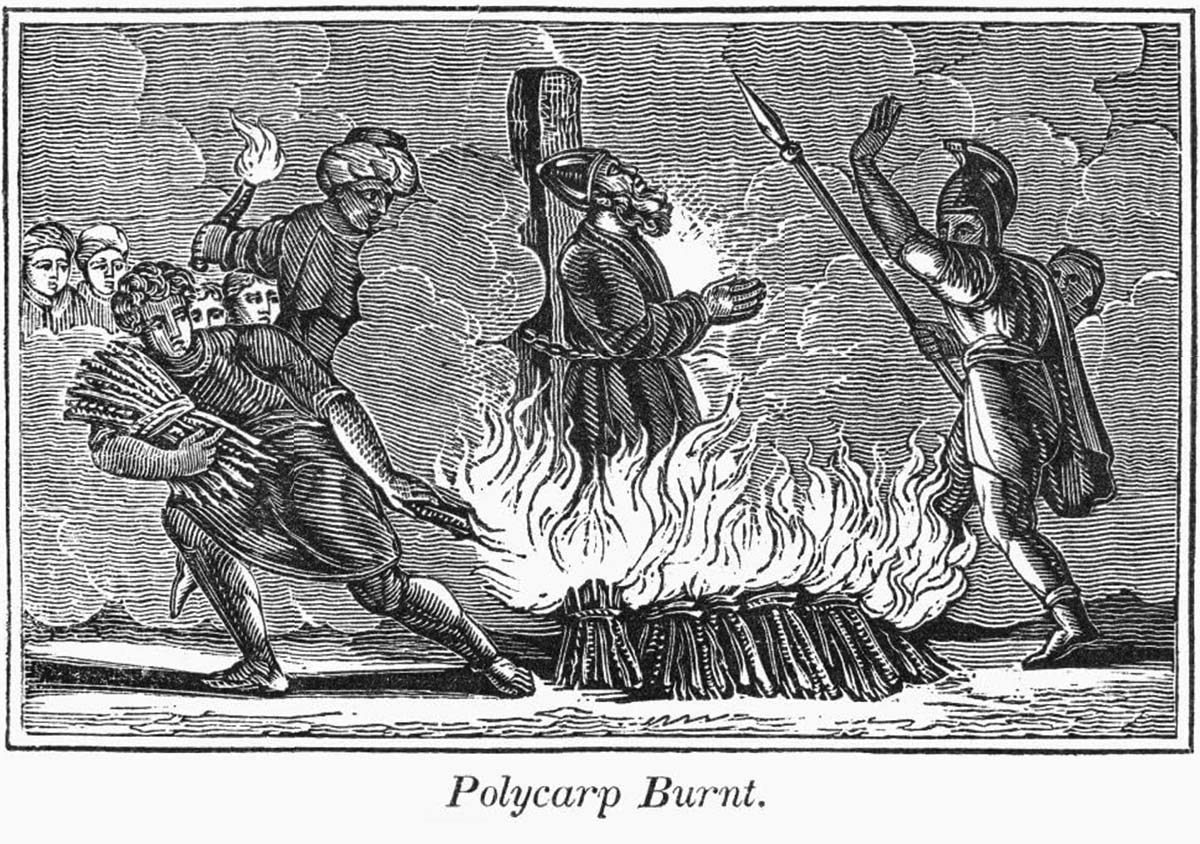
Woodcut from an 1832 edition of John Foxe’s Book Of Martyrs.