
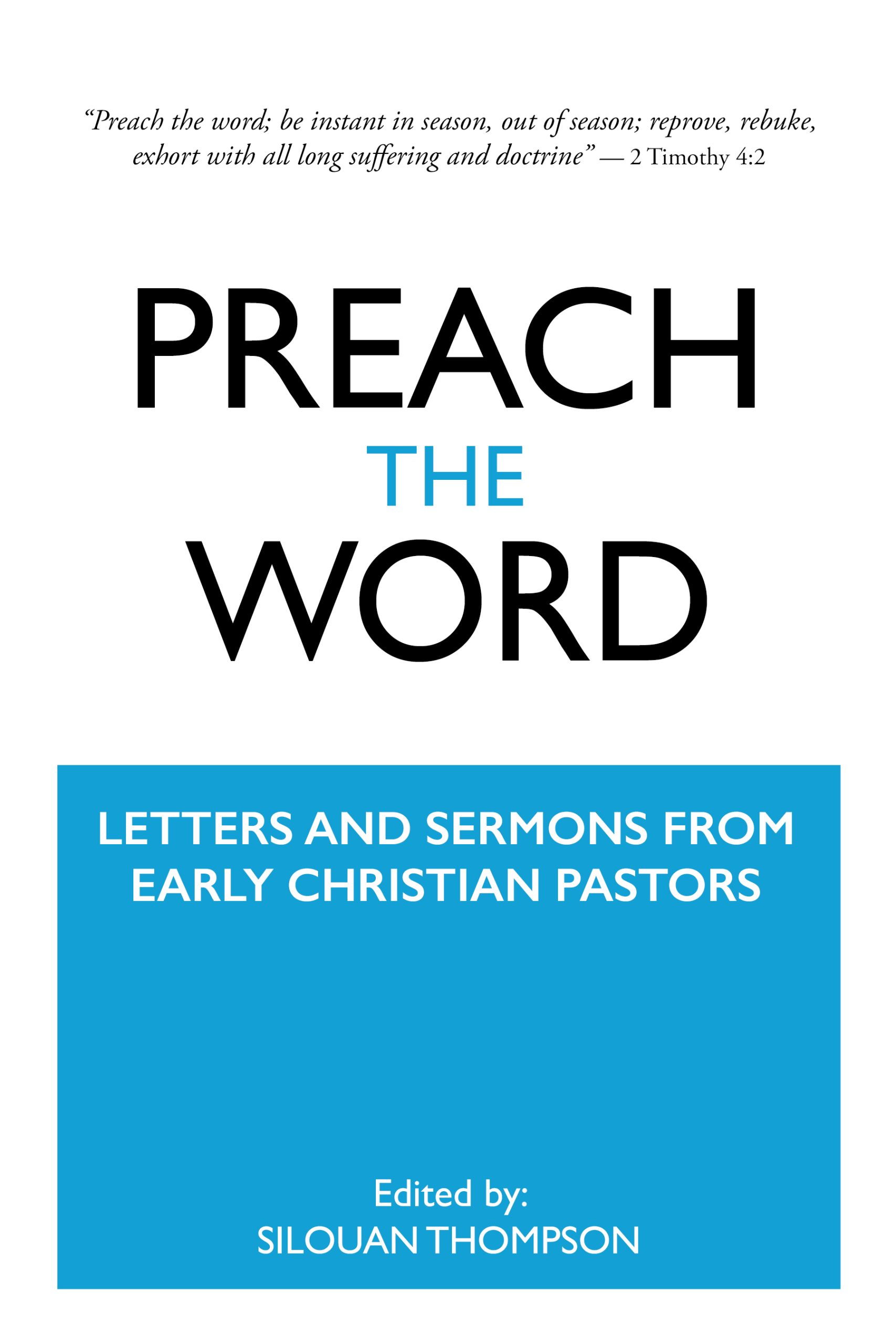
Preach the Word: Letters and Sermons from Early Christian Pastors
Paperback, 214 pages
$18.99

About this site
This website is intended to be an online companion to the book Preach the Word: Letters and Sermons from Early Christian Pastors, providing easy reference to the earliest texts by Christian teachers in a clear, modern English version. It arises out of a project begun in 2024 which resulted in the first print edition of Preach the Word.
Why this book exists
This book began in a series of readings I undertook over twenty-five years ago. I wanted to demonstrate that the central tenets of my faith – the Trinity, the divinity of Christ, the order of Christian worship – were not merely imposed on the text of scripture, but were shared by every generation of Christians, back to the earliest communities who first received the newly-written letters that became our New Testament. I wanted to be able to say with certainty that I, and the people I was serving as a pastor, were in the mainstream of normal Christian faith and practice.
The early Christians had most of the same biblical texts we have today. How did they read them, teach them, and put them into action? How do our contemporary beliefs and applications of scripture compare to what was being believed and done in the first, second, or third centuries by Christian communities who still had the living memory of the apostles’ teaching? It turned out that the Christians of the first few centuries were not silent, and their words were not lost; it was possible to let them speak in their own words.
In the pages that follow, these early Christian writers will address one another – not usually to convince the reader of a new doctrine, but to exhort one another to faithfulness, unity, and service to Christ and his people. What they assume will be even more enlightening than what they assert.
My prayer is that the reader will have the opportunity to hold up the faith of the first Christians as a lens through which to evaluate the beliefs and practices of twenty-first century Christianity.
About the Texts
The sermons and letters presented here are chosen from a wealth of writing by early Christians, including pastoral works, apocalypses, apologetics, and gospels. These texts in particular were chosen because of their universal acceptance as authentic, both among ancient Christians and by academic scholars today, and because of their relevance to our own generation’s need for a way of life and worship grounded not in internet arguments, or denominational distinctives, but in firsthand testimony of authentic apostolic faith. These letters and sermons also share in common the characteristic of exhorting and explaining, but not attempting to convince or convert the reader.
For further reading: Bibliography.The letters of Clement, Ignatius, Polycarp, the Didache, and the letter to Diognetus are excerpted and adapted from a translation by Cyril C. Richardson, which is now in the public domain. Melito’s On the Passover was translated by Gerald F. Hawthorne in Current Issues in Biblical and Patristic Interpretation, ©1975 by Wm. B. Eerdmans Publishing Company, and is used by gracious permission. The Martyrdom of Perpetua and Felicity is adapted from translations by R.E. Wallis and W.H. Shewring, with reference to the Greek text edited by Seumas Macdonald. The texts of Athanasius’ On the Incarnation and Answering the Jews are excerpted from the 1944 English translation On the Incarnation of the Word, originally credited as “Translated and edited by A Religious of C.S.M.V.” This translation was in fact the work of Sister Penelope Lawson, of the Anglican Community of Saint Mary the Virgin in Wantage, England. It was significantly revised for the present book with much reference to On the Incarnation (Greek and English), translated by Archpriest John Behr, and On the Incarnation of the Word, translated by Alexander Walker in Nicene and Post-Nicene Fathers. This text comes from a somewhat later period than the rest of the material collected here, but it seems important to include because of the clarity of the author’s vision of how the incarnation of Christ accomplishes the salvation of mankind, in a period when neither the Nicene Creed nor any formal dogma of penal substitution had yet been enunciated. The essay Against the Gentiles, which usually accompanies On the Incarnation, is omitted here as it addresses philosophical controversies less applicable outside the writer’s fourth-century context. Quotations from Eusebius are from Paul Maier’s Eusebius: the Church History.
For consistency, all citations from the Psalms are numbered according to the Septuagint. Other citations are labeled lxx only when the Septuagint, as quoted by the original author, differs significantly from the modern Masoretic Text.
Most of these texts have been extensively adapted and edited for this edition, with counsel from wiser and better-read scholars. Any errors are purely my own.