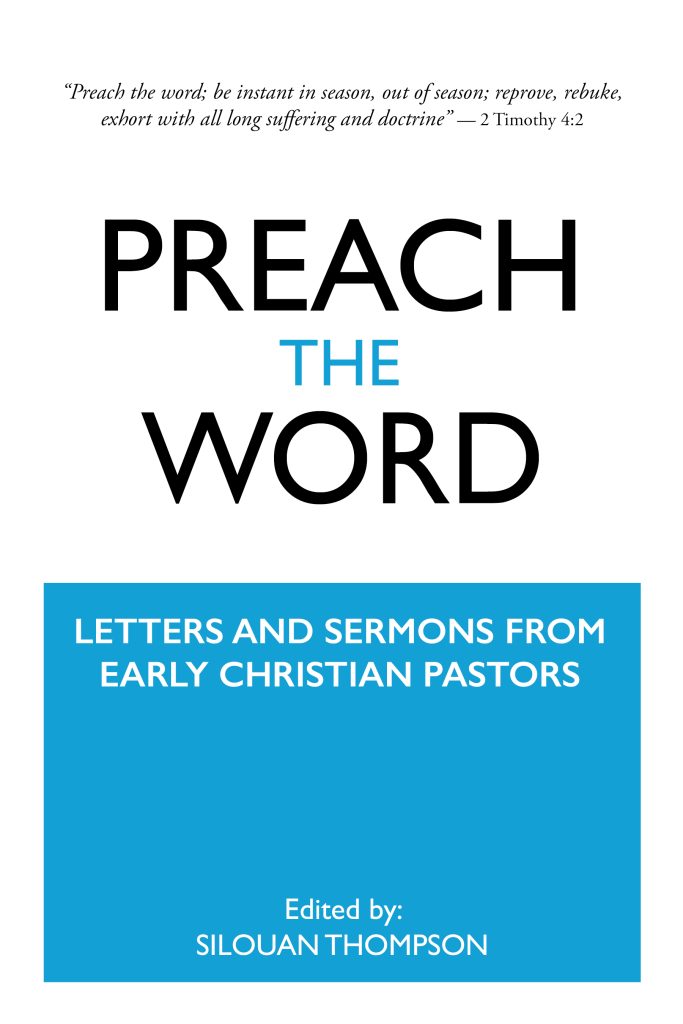
The Letter to Diognetus

Author: Unknown Introduction The author of the letter is unknown. One strong candidate is Quadratus of Asia Minor, who about AD 129 addressed an Apology to the emperor Hadrian, a fragment of which is preserved in the Ecclesiastical History of Eusebius. The writer of the letter does not quote the text of scripture but is plainly influenced by the tradition of John the Evangelist, leading scholars to assign it to second-century Asia Minor. The real beauty of this letter is its picture of the Christian life, the freshness of its language, and the simplicity of its theology, pointing to the authenticity of the letter as an expression of early Christian faith. An Argument for the Christian Faith To His Excellency, Diognetus: I understand, sir, that you are genuinely interested in learning about the religion of the Christians, and that you are making an accurate and careful investigation of the subject. You want to know, for instance, what God they believe in and how they worship him, while at the same time they disregard the world and look down on death, and how it is that they do not treat the divinities of the Greeks as gods at all, although on the other hand they do not follow the superstition of the Jews. You would also like to know the source of the loving affection that they have for each other. You wonder, too, why this new race or way of life has appeared on earth now and not earlier. I certainly welcome this keen interest on your part and I ask God, who gives us the power to speak and the power to listen, to let me speak in such a way that you may derive the greatest possible benefit from listening, and to enable you to listen to such good effect that I may never have a reason for regretting what I have said. Now, then, clear out all

Read More »

Melito of Sardis

Melito (c. AD 100 – c. 180) was bishop of Sardis, near Smyrna in Asia Minor. Sardis is one of the cities addressed in the Revelation (3:1). Eusebius, in his fourth-century Church History, quotes a letter of Polycrates, a bishop in Asia Minor, to Bishop Victor of Rome, dated c. AD 186-195. Among other “great lights who have died” in Asia, he names “Melito the eunuch, who governed all things in the Holy Spirit, and who lies at Sardis awaiting the visitation from the heavens when he shall be raised from the dead.”Eusebius, Hist. eccl. V. 24. Jerome quotes a lost work by Tertullian which recounts that many people considered Melito a prophet.Jerome, De Viris Illustribus, ch. 24. Related On the Passover

Read More »

Polycarp of Smyrna

Related: Letter of Polycarp, Bishop of Smyrna, to the Philippians Martyrdom of Polycarp At the time of his martyrdom, Polycarp, the bishop of Smyrna (Modern İzmir, Türkiye), confessed that he had been a Christian for eighty-six years. Since the date of his martyrdom can be fixed with reasonable certainty in A.D. 155 or 156, his birth could therefore not have been later than the year 69 or 70. This makes him perhaps forty years of age when he visited and corresponded with Ignatius on the latter’s way to martyrdom in Rome. Polycarp’s life spanned that critical era of the Church’s development following the passing of the apostles, and encompassed the menacing growth of state persecution, the Docetic and Gnostic heresies, and the coalescence of the canon of New Testament writings. Woodcut from an 1832 edition of John Foxe’s Book Of Martyrs.

Read More »

On the Passover

Author: Melito of Sardis Date: AD 160–170 Related: Something strange is happening Introduction Melito wrote this homily between AD 160–170. The text reveals that it was a liturgical poem preached during the celebration of the resurrection of Christ. His text is the account of the Passover in the twelfth chapter of Exodus. The form of the homily is based on the Haggadah, the annual retelling of the works of God at Passover. The Greek title of this text is Peri Pascha. The Hebrew word for “to skip” or “to omit” is Pesach; in Aramaic and Greek this becomes Pascha. This is the word translated “Easter”Acts 12:4 KJV. or “Passover” in English editions of the Bible, referring to God’s passing over the homes of the Hebrews when judging the Egyptians. To the Greeks this word has an additional implication, as it resembles the Greek verb paschō, “to suffer,” and so alludes to the passion and resurrection of Christ. It is interesting that Melito does not quote the New Testament, though he is obviously well-versed in the oral tradition of the Gospel. On the Passover Introduction (1-10) 1 First of all, the Scripture about the Hebrew Exodus has been read and the words of the mystery have been explained as to how the sheep was sacrificed and the people were saved. 2 Therefore, understand this, O beloved: The mystery of the Passover is new and old, eternal and temporal, corruptible and incorruptible, mortal and immortal in this fashion: 3 It is old insofar as it concerns the law, but new insofar as it concerns the gospel; temporal insofar as it concerns the type, eternal because of grace; corruptible because of the sacrifice of the sheep, incorruptible because of the life of the Lord; mortal because of his burial in the earth, immortal because of his resurrection from the dead. 4 The law is old, but the gospel is new; the type was

Read More »

The Didache

Author: Unknown Date: c. AD 70–100 Introduction In October 1873, theologian (and later Metropolitan of Nicomedia) Philotheos Bryennios made a monumental discovery in the depths of the library of the Great School of the Nation in Istanbul. He found a complete manuscript of the late first-century catechism known as the Didachḕ Kyríou dià tō̂n dṓdeka apostólōn toîs éthnesin or “The Lord’s Teaching Through the Twelve Apostles to the Nations.” This important document had been known by name since at least the fourth century, and it had been quoted in Christian literature including the Apostolic Constitutions, Didascalia, and the Stromata of Clement of Alexandria, (d. AD 215) but it was thought to have been lost to history, preserved only in fragments and quotations in other works. The Didache falls into two parts. The first is a code of Christian morals, presented as a choice between the way of life and the way of death. The second part is a manual of church order which lays down some simple rules for the conduct of a rural congregation. It deals with such topics as baptism, the Eucharist, fasting, itinerant prophets, and the local ministry of bishops and deacons. It concludes with a warning paragraph on the approaching end of the world. The “Two Ways” The first part of the Didache bears a close relationship to several other early Christian writings. The moral catechism or “Two Ways” of chapters 1 to 5 appears in a rather different version at the end of the Letter of Barnabas (dated between AD 100 and 130), and has also come down to us as an independent document in a Latin translation. Some contend that the “Two Ways” was originally an independent catechism for proselytes, perhaps Jewish in origin, and that it has been incorporated in different forms by the various compilers. The Church Order The second part of the Didache, chapters 6 to 15, is a manual of Christian

Read More »